You know that feeling when the bank sends you a “Great Offer!” and then the PDF is 7 pages long… and your first reaction is, “Aiyo, later lah… not now.”
You’re not alone.
Most Malaysians don’t read every line. But the painful part is this:
The important traps are almost always inside those lines.
Let’s go through how to read a loan offer like a normal human, not a lawyer. I’ll keep it as if we’re chatting at a mamak table – step by step, in plain English 😉
1. Start with the basics: what, how long, how much per month
Before you worry about all the technical stuff, confirm these three:
- Loan amount – How much are you actually getting?
- Sometimes the “approved amount” includes fees or insurance that are deducted upfront.
- Tenure (years/months) – How long you’ll be paying.
- Longer tenure = lower monthly instalment,
- but usually higher total interest across the whole loan.
- Monthly instalment – The amount you must pay every single month.
Most banks in Malaysia show this clearly on the first page or in the Product Disclosure Sheet (PDS) – they are required to explain key details like loan amount, tenure, and example monthly repayment.
If these three don’t match what the salesperson told you, pause. Don’t rush to sign.
2. Look at the interest rate – and the “effective” one
In Malaysia, banks now have to be clearer about how they show costs:
- They must disclose the effective interest/profit rate and total repayment, not just a “pretty” headline rate.
You’ll usually see things like:
- “Interest rate: BR + 1.5% p.a.”
- “Effective lending rate: X% p.a.”
For housing loans, you’ll see Standardised Base Rate (SBR) or Base Rate (BR). That base rate is linked to Bank Negara’s Overnight Policy Rate (OPR), so it can move up or down over time.
What matters to you:
- Is it fixed or variable?
- Fixed: same rate for the whole tenure.
- Variable: can change if SBR/BR changes.
- What is the effective rate?
That’s a better reflection of the real cost after taking into account how interest is calculated.
If you only remember one thing about interest:
Don’t just compare “headline rates” on posters. Compare the effective rate and total repayment.
3. Find the total repayment amount
Somewhere in the offer or PDS, there is usually a line like:
“Total amount you must pay over the loan tenure: RM XXX,XXX.”
This is super important because it tells you:
- How much extra you’re paying on top of the amount you borrow.
- Whether the “cheap” monthly instalment is actually very expensive over 7–10 years.
Banks in Malaysia are increasingly required to show this clearly so you can make informed choices.
If the total repayment shocks you, that’s a sign to:
- Reduce the amount,
- Shorten the tenure (if you can afford higher monthly), or
- Reconsider the whole idea.
4. Don’t skip the fees and charges
This part is where many people kena.
Common things to look for:
- Processing / handling fee – One-off fee for giving you the loan.
- Stamp duty & legal fees – Common for housing and business loans.
- Insurance / Takaful – Sometimes bundled into the loan amount (for example, Mortgage Reducing Term Assurance).
- Commitment fee or annual fee – For some business or flexible facilities.
Questions to ask yourself:
- Are these fees added on top of the loan, or deducted at the start?
- If deducted, will I still receive enough cash for what I actually need?
- Are there any “other charges as per bank’s policy” that are not clearly explained? Ask.
A loan with slightly higher interest but lower fees can sometimes be cheaper overall than a “low interest” loan with high processing fees and bundled products.
5. Check for lock-in period and early settlement rules
For housing loans and some term loans, there can be a lock-in period – for example, 3–5 years.
During this time, if you:
- Fully settle the loan, or
- Refinance to another bank,
you may be charged an early settlement penalty.
You’ll see this in the PDS or key terms as:
- “Early settlement fee: X% of outstanding amount if redeemed within Y years”, or
- “Lock-in period: 3 years”.
Make sure you’re okay with:
- How long you are tied to this bank
- How much it costs if you want to refinance later for a better rate.
6. Read the part about late payment and default
I know, this is the scary part – but better to be scared now than shocked later.
Look for:
- Late payment charges – flat fee or % of overdue amount.
- Whether late payments trigger higher interest or other penalties.
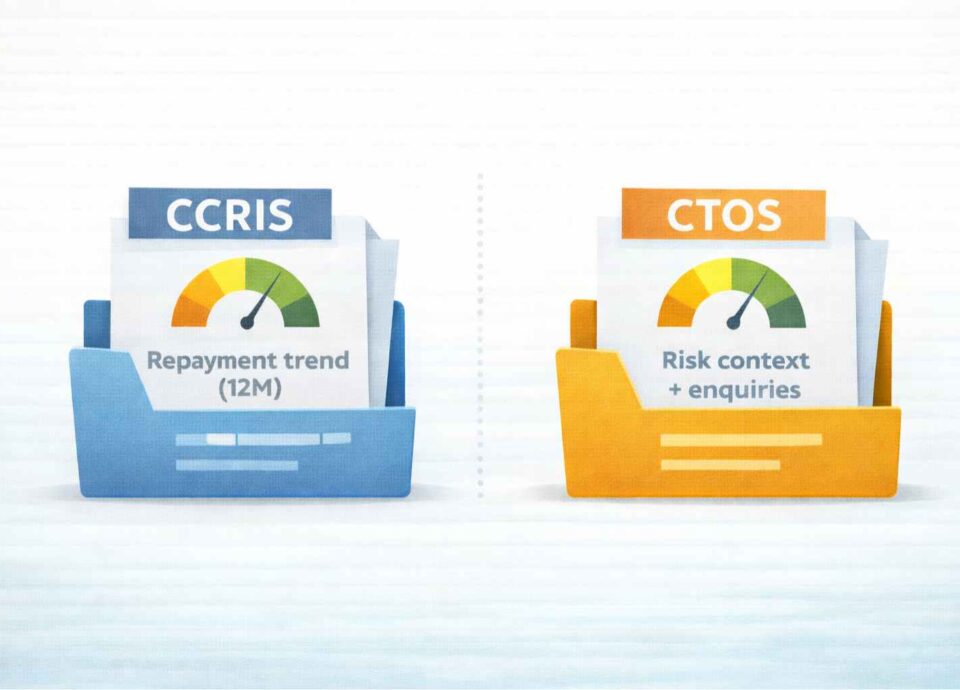
Also, remember: even one or two missed payments can show up on your CCRIS report. CCRIS (run by Bank Negara) records your repayment history for the last 12 months. A ‘0’ means on time, ‘1’ means one month late, ‘2’ means two months late, and so on.
CTOS and other credit agencies also highlight late payments as a big factor in your credit score.
So don’t just look at the late fee (RM50, RM100).
The bigger damage is on your future borrowing.
7. Look out for “extras” you didn’t really ask for
Some loan offers quietly bundle in products like:
- Insurance/takaful you didn’t really plan to buy,
- Credit cards,
- Overdraft facilities,
- “Protection plans”.
Sometimes they’re helpful. Sometimes they just add cost.
Check:
- Is this insurance/takaful optional or compulsory?
- If it’s optional, do I really want it, or is it just making the loan look “approved easily” but more expensive?
Again, the details are often in the PDS or the extra pages, not the first “nice” summary page.
8. If you feel blur, don’t be shy to ask
You’re not supposed to magically understand everything.
If something is unclear:
- Ask the bank officer to explain in simple words –
“If I miss one payment, what exactly happens?”
“If SBR goes up by 1%, how much more do I pay each month?”
“If I settle in year three, what fees do I pay?” - If you still don’t feel right, get a second opinion from someone neutral – a trusted advisor, or even compare PDS from other banks online.
Banks and lenders in Malaysia are expected to follow clearer disclosure standards and responsible lending guidelines – that’s the direction Bank Negara has been pushing.
Use that to your advantage. You have the right to understand fully before you sign.
Final thought: Don’t rush the signature
A loan can be helpful. It can also become a long, heavy burden.
Before you sign:
- Make sure the monthly instalment is truly affordable after you budget for real life (food, kids, parents, emergencies).
- Make sure you’ve read the key parts: interest, total repayment, fees, lock-in, late payment, and any extras.
- Don’t let anyone rush you with “today only promotion” if you haven’t read properly.
If you feel lost or overwhelmed by multiple offers, it’s okay to ask for help.
Sometimes having someone sit on your side of the table, go through the pages with you, and translate everything into normal English is exactly what you need before making a big decision.
You don’t have to become a lawyer.
You just need to slow down, ask questions, and make sure every line you sign is something you truly understand 🙂