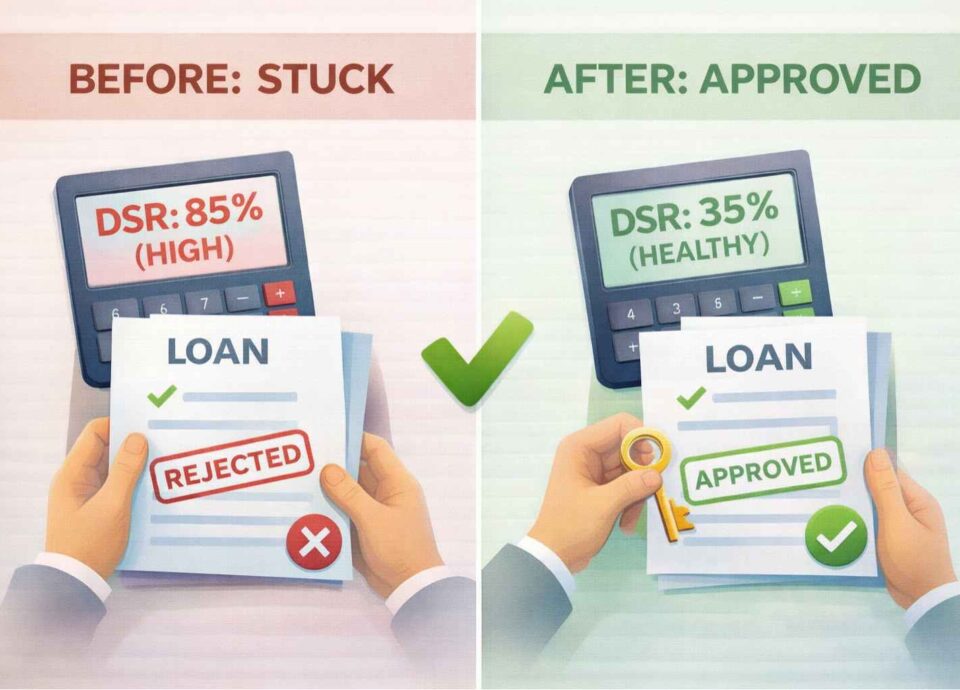
Most Malaysians get stuck here: “My CCRIS/CTOS got issue… but which one is actually blocking the loan?”
Here’s the simple map:
- CCRIS = repayment behaviour (12 months).
- CTOS = risk context (records + links + sometimes a score).
- Banks use both to answer one thing: can you afford it, and are you safe to lend to?
This guide explains what each report shows, what underwriters usually focus on in 2026, and what you should fix first—so you don’t burn your chances with random applications.
What is CCRIS in Malaysia?
CCRIS is a credit report that shows your financing facilities and your repayment conduct over the last 12 months (how consistently you’ve been paying). It’s not a “credit score.” Banks typically treat CCRIS like your repayment “track record” and look for stability, especially in the most recent months.
What CCRIS typically shows
- Your financing facilities (type, limit/amount, outstanding, instalment)
- 12-month repayment conduct (the line banks stare at first)
- Monthly arrears pattern (banks care about the trend, not just one number)
NYK note: In our work, CCRIS is usually the first “gate.” If the recent pattern looks unstable, everything else becomes harder.
What is CTOS and why do banks check it?
CTOS is a credit reporting agency report that may include risk-related signals such as legal records (if any), directorship/business links, and search history. Some CTOS report types also show a CTOS Score, but banks usually read CTOS as “context”—to spot surprises or clarify risks.
What CTOS may include (depends on report type)
- Directorships / business ownership links
- Legal action / litigation-related records (if any exist)
- Search history (how often lenders checked you)
- A CTOS Score (on certain report types)
NYK note: CTOS is where “unexpected stuff” shows up—old disputes, company links, or multiple recent checks.
CCRIS vs CTOS: what’s the real difference?
CCRIS tells banks how you pay. CTOS helps banks judge wider risk context. They’re not the same thing and banks don’t treat them as competitors. One is behaviour (repayment history), the other is context (risk signals).
| Item | CCRIS | CTOS |
|---|---|---|
| Main purpose | Repayment behaviour + financing facilities | Risk context (records/links/searches; sometimes score) |
| Time lens | Strong focus on last 12 months | Varies by record type (some items can be older) |
| “Score” | No score | Some report types include a score |
| Why banks care | Repayment discipline | Extra risk flags + verification |
What do Malaysian banks actually care about in 2026?
Most banks still decide based on three pillars: affordability, repayment behaviour, and risk flags. The tools and scoring models differ by bank, but the logic is consistent: the bank wants proof your repayments are sustainable and your profile is low-risk—without tight buffers or hidden surprises.
1) Affordability (your buffer matters)
Banks look at income versus total commitments. Even if you “can pay”, if your buffer is too thin, it may be considered risky.
They typically ask:
- After paying all debts, do you still have enough for living costs?
- If something goes wrong (car repair, medical, business slow month), do you collapse?
2) Repayment behaviour (CCRIS trend is the headline)
Banks look for:
- Clean recent months
- No repeated late-payment pattern
- No “up-down” repayment conduct
Reality: One bad month is sometimes explainable. A pattern is harder to defend.
3) Risk signals (CTOS can trigger questions)
Banks pay attention when CTOS shows:
- Legal records that need explanation
- Unclear business/directorship links
- Heavy “credit shopping” (many checks in a short time)
Reality: Banks hate ambiguity. If something exists, be ready with a clear, consistent story.
How to read the “0 / 1 / 2” line in CCRIS (simple)
The monthly indicator generally reflects arrears behaviour for that period: “0” usually means no arrears, while “1/2/3…” indicates months in arrears. Underwriters focus on the trend—especially the most recent months—because it signals whether you’re stabilising or slipping.
NYK tip: If you’re repairing your profile, your goal is simple: build a clean, stable recent streak.
| Red flag | Usually shows up in | What the bank may think | What you should do first |
|---|---|---|---|
| Recent arrears trend | CCRIS | “Repayment risk” | Stop applying everywhere. Stabilise repayments first. |
| Commitments too tight | Affordability assessment + CCRIS facilities | “No buffer / high risk” | Reduce obligations or restructure only if it truly lowers monthly burden. |
| Legal/litigation record | CTOS (if any) | “Needs clarification” | Prepare documents and explain status clearly. |
| Directorship/business links unclear | CTOS | “Hidden exposures” | Make liabilities transparent and consistent with your declared profile. |
| Too many recent checks | CTOS search history | “Credit shopping” | Pause and apply strategically (one good application beats five random ones). |
What should you fix first (so you don’t waste applications)?
If CCRIS is the main problem
- Clear arrears and rebuild a clean recent trend
- Avoid new commitments while repairing your last 6–12 months
- Don’t mass-apply and “test luck” (it often backfires)
If CTOS is the main problem
- Identify the exact item causing concern (legal record? business link? too many checks?)
- Organise proof of settlement/resolution where relevant
- Prepare a clean explanation that matches your application profile
If affordability is the main problem
- Don’t “solve” it by stretching tenure blindly
- Focus on reducing the real monthly burden (not just moving numbers around)
- Choose the bank/product that matches your profile instead of chasing any approval
Common myths that waste people’s time
1. “CTOS score low = auto reject”
Not necessarily. A score can influence the risk view, but banks still weigh affordability and repayment behaviour heavily.
2. “CCRIS bad means forever cannot”
Not true. What usually matters most is whether your recent months show stability and improvement.
3. “Apply many banks faster get yes”
Often the opposite. Too many checks can look like desperation, and it reduces your room to manoeuvre.
What if your report is wrong?
If you spot inaccurate information, dispute and correct it through the proper channel before you apply again. Don’t assume it will “auto update” in time. If your application is time-sensitive, start the correction process early.
NYK tip: We’ve seen approvals delayed simply because a borrower waited too long to correct one wrong item.
What to do next if you were rejected
If you want to stop guessing, do this in order:
- Pull your latest CCRIS and CTOS
- Identify which bucket you’re in:
- CCRIS repayment trend issue
- CTOS risk-flag issue
- affordability/buffer issue
- Fix the right thing first, then apply once with a clean plan
If you want us to assess it properly, send:
- a screenshot of your CCRIS repayment conduct section, and
- your CTOS highlights (score page + any legal/directorship sections)
We’ll tell you what’s actually blocking you and the most realistic next move: refinance, restructure, consolidate, or pause and repair first.
Conclusion
If you remember only one thing:
CCRIS is behaviour. CTOS is context.
And banks approve when the story is simple: stable repayments + safe buffer + no unexplained surprises.
So don’t try to “fix everything.” Fix the right thing first:
- CCRIS messy → stabilise the trend
- CTOS surprises → clarify and document
- affordability tight → reduce real monthly burden
That’s how you go from “rejected with no explanation” to “approved with confidence.” 😉